

AI CRM for Real Estate: How Artificial Intelligence is Changing Property Sales in India

India’s real estate sector is more competitive than it has ever been. Brokers, channel partners, and developers are dealing with higher digital inquiry volumes, faster buyer expectations, and tougher competition across cities. With leads flowing in from property portals, Meta ads, Google searches, websites, and walk-ins, the real struggle is no longer lead generation. It is lead management and follow-up consistency.
This is where automated lead distribution and follow-up intelligence can transform the way sales teams perform. It not only cuts manual work but also strengthens conversion rates by making sure every inquiry is addressed on time.
In this detailed guide, you will understand how Indian real estate professionals can structure lead routing, automate follow-ups, balance team load, and build a predictable sales engine using a modern CRM like Makanify.
Why Lead Distribution Matters in Indian Real Estate
Every second lost in assigning a lead directly affects the chance of conversion. Research shows that responding within 5 minutes can increase conversions significantly compared to responding after 30 minutes or one hour. Indian buyers expect quick updates because most inquiries come through mobile channels.
In many agencies and developer sales teams, delays happen because of:
- Manual assignment from Excel sheets
- Lack of clarity on who is available
- Follow-ups handled on personal phones
- No central visibility for managers
- No accountability for missed leads
Automating distribution solves these problems and creates a predictable, fair, and transparent workflow.
Understanding Lead Sources in 2025
Before designing a routing strategy, you need clear visibility of where your leads originate. In India, brokers and developers usually receive inquiries from:
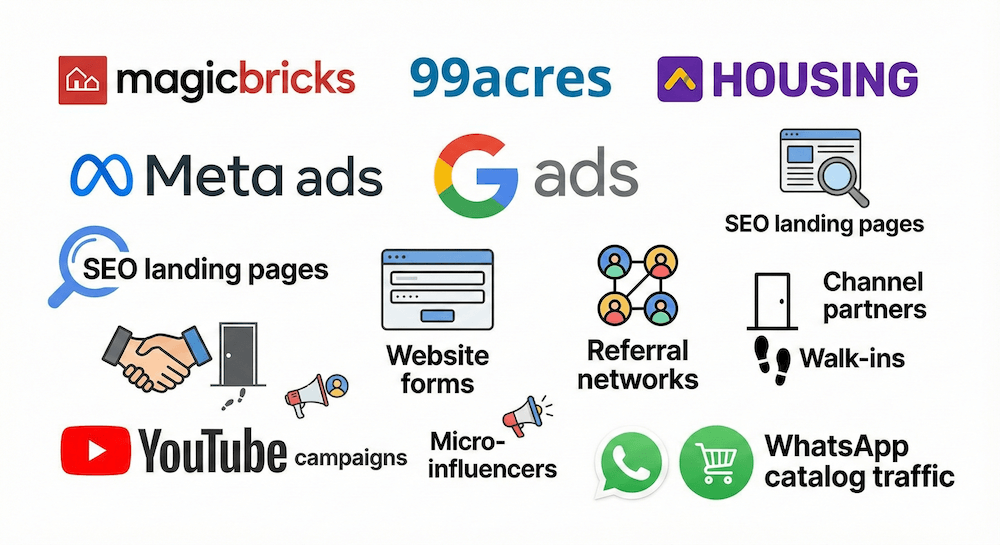
Your CRM must automatically capture these in real time. Lead loss from manual transcribing is one of the biggest issues teams face.
Designing a Smart Lead Distribution System
Most Indian real estate teams use one of the following allocation systems:
1. Round Robin Assignment
Leads are assigned in a rotating cycle. This is ideal for teams with equal experience levels. It prevents accusations of favoritism and ensures fair distribution.
2. Equal Distribution
Leads are divided based on quotas. Senior members may take fewer, high-quality leads while juniors handle more volume.
3. Skill or Project Based Assignment
Leads interested in a particular project or locality go to the specialist trained for that segment. This boosts closing rates.
4. Source Based Assignment
For example:
- Meta ads go to digital team leads
- MagicBricks and 99acres go to portal specialists
- Website leads go to top closers because they have higher conversion potential
5. Priority-Based Assignment
- Leads are scored using AI models.
- Hot leads go directly to senior closers.
- Warm leads go to mid-level associates.
- Cold leads go to nurturing teams or drip automation.
Automation Rules That Indian Teams Should Consider
A powerful CRM lets you write rules that work silently in the background. Below are essential automations that Indian real estate teams should enable.
Lead Assignment Automations
- Assign lead to a team member based on budget range
- Assign based on project interest
- Assign based on preferred location
- Assign based on type (buy, sell, rent, lease)
- Reassign if no action is taken within a defined period
- Assign to night-shift or regional teams based on time
Follow-up Automations
- Auto send WhatsApp greeting after first inquiry
- Auto send property brochure link within seconds
- Auto remind sales reps if follow-up is pending
- Auto reassign leads with no response after 48 hours
- Auto send price updates or construction updates to warm leads
- Auto trigger cart abandonment-like alerts for dropped inquiries
Automation not only saves time but also stabilizes your sales cycle.
Understanding Follow-up Timing in Indian Market Conditions
The Indian buyer journey is different from Europe or the United States. Buyers compare multiple options, involve family members, consult financial advisors, and often take weeks before deciding.
This means your follow-up strategy must be:
- Consistent
- Polite
- Informative
- Based on buyer intent
- Structured across multiple channels
The recommended follow-up pattern in Indian real estate:
- Day 1: Immediate WhatsApp reply, introductory call attempt
- Day 2: Project brochure and price sheet
- Day 4: Follow-up with USP and availability insight
- Day 7: Share site visit invitation
- Day 15: New updates, offer alerts, or progress photos
- Every 30 days: Drip updates for long-term prospects
A CRM ensures this cadence is maintained without human effort.
Role of WhatsApp in Real Estate Automation
WhatsApp is the backbone of Indian real estate communication. A CRM integrated with official WhatsApp API can send:
- Auto welcome messages
- Brochures
- Floor plans
- Location pins
- Site visit confirmation
- Payment reminders
- Booking updates
Since WhatsApp is already trusted by buyers, your message open rate stays very high.
How AI Improves Lead Distribution
AI models can study your historical sales data and find patterns such as:
- Which team member closes best for high-ticket projects
- At what time your team responds fastest
- Which project needs priority attention
- Which channels convert best
- Which leads require immediate outreach
AI also predicts buyer intent based on behavior:
- Link clicks
- Brochure views
- Frequency of WhatsApp replies
- Time spent on inventory pages
- Number of questions asked
CRM teams can then create rules like:
- Assign hot leads to senior closers
- Delay cold leads until they show more engagement
- Prioritize project A this week based on rising demand
This gives you a clear sales advantage.
Tracking Team Productivity
Once distribution is automated, the next step is visibility. Managers should be able to measure:
- Total assigned leads per user
- Response time
- Follow-up consistency
- Number of calls attempted
- Site visits scheduled
- Conversions by source
- Conversions by project
- Pending tasks
- Missed opportunities
A modern CRM generates these reports automatically.
Common Mistakes Indian Teams Make
Many real estate teams still lose sales because of:
- Relying only on WhatsApp and phone memory
- No defined follow-up structure
- No standard assignment rules
- No CRM adoption checks
- Lack of training
- Manual data entry
- Delayed responses
- Staff turnover without clear data transfer
Avoiding these mistakes is the simplest way to increase revenue.
Building a Complete Lead Automation Framework
Here is a simple blueprint:
Step 1: Capture
Integrate portals, Meta, Google, website forms, channel partner referrals, and custom links.
Step 2: Score
Use AI scoring to identify hot, warm, cold stages early.
Step 3: Distribute
Use assignment rules based on project, location, team structure, or workload.
Step 4: Follow-up
Automate WhatsApp, SMS, and email drips with timelines.
Step 5: Measure
Use dashboards and activity logs to measure performance.
Step 6: Improve
Iterate rules based on project demand and team output.
Business Research Insights. Global Real Estate CRM Market Forecast 2025 to 2032. https://www.businessresearchinsights.com/
Industry benchmarks on lead response time from Harvard Business Review. https://hbr.org/
Conclusion
Lead automation and smart distribution are the real differentiators for Indian real estate teams in 2025. The market is getting more digital and more competitive every quarter. Buyers expect timely responses, clear information, and consistent communication.
A CRM like Makanify already solves these challenges by offering automated lead routing, WhatsApp-based follow-ups, AI scoring, drip marketing workflows, and central visibility for managers. Teams that adopt automation in 2025 will stay ahead in sales velocity, customer experience, and operational efficiency.